

Evaluating the 1922 Peace Dollar requires separating its intrinsic 1922 Peace Dollar value as a silver bullion piece from its market price as a historical artifact.
Despite containing 24.05 grams of pure silver in each coin, high-preservation specimens demonstrate price dynamics independent of stock market metal quotes.
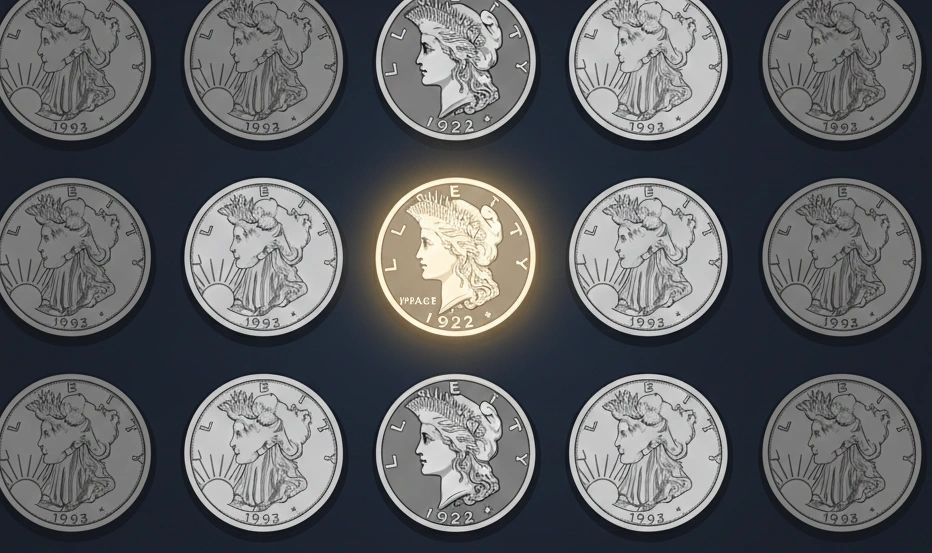
The coin was issued under the Pittman Act, mandating the replacement of previously melted Morgan dollars.
The minting process was carried out using low-relief dies following unsuccessful attempts at mass-producing high-relief coins in early 1922.
Characteristic | Value |
Coin Weight | 26.73 grams |
Alloy Composition | 90% Silver, 10% Copper |
Silver Content | 24,05 grams |
Diameter | 38.1 mm |
Edge Type | Reeded |
Silver Value and Collector Premium
The "melt value" represents a fundamental price floor determined by global raw material markets.
With silver priced at $25 per ounce, the intrinsic metal value in the coin amounts to $19.33 USD.
However, the market price of certified specimens in MS 65 condition exceeds this threshold by more than 8 times.
The difference between the metal value and the market price is called the numismatic premium, reaching 50,000% for the rarest specimens.
The production scale in 1922 was the largest in the history of the Peace Dollar series.
Mint Facility | Mark under the word ONE | Production Volume |
Philadelphia | None | 51,737,000 |
Denver | D | 15,063,000 |
San Francisco | S | 17,475,000 |
The enormous mintage of the Philadelphia Mint ensures an oversupply of low-quality coins, pressing their price toward the silver value.
For comparison, coins from Denver and San Francisco in similar high grades are encountered less frequently due to specific working die wear at these facilities.
Price on the Sheldon Scale
Grading is a key pricing tool transforming an ordinary coin into an investment asset.
Grade | Condition | Average Price (USD) | Metal Premium (%) |
AU 58 | Almost Uncirculated | $35 – $40 | ~100% |
MS 63 | Uncirculated (Choice) | $60 – $80 | ~300% |
MS 65 | Gem Luster | $160 – $220 | ~1,000% |
MS 66 | High Preservation | $600 – $950 | ~4,500% |
MS 67 | Exceptional Rarity | $18,000 – $25,000 | ~100,000% |
Market Value Changes
Statistical data for the period from 2010 to 2024 show a divergence in trends for different preservation groups.
Coins in MS 60–63 grades demonstrate a correlation with the silver price at a 0.85 level, almost completely mirroring precious metal chart movements.
Specimens in MS 66 grade show independent growth, averaging 4.8% annually, regardless of silver price drops.
With a sharp increase in the number of certified MS 65 coins in PCGS/coin value app registries, the price in this segment may stagnate or drop by 2–4% annually due to demand saturation.
The 1922 High Relief Factor
In early 1922, the Philadelphia Mint produced a limited number of coins with high-relief images using 1921 dies.
These specimens are classified as transitional and possess unique market value.
The discovery of such a coin in MS 67 condition led to a sale at $105,750 USD at a Heritage Auctions event.
The number of confirmed 1922 High Relief specimens is counted in the dozens, while the ordinary low-relief mintage reaches tens of millions.
Defects as a Source of Value
Certain production deviations increase a coin's value, making it unique in the eyes of professional appraisers.
VAM Varieties: Identifying specific die pairs (e.g., VAM-3 with a damaged die) adds 20–50% to the price beyond the standard grade.
Die Clashes: Obverse detail impressions on the reverse and vice versa occur when the press activates without a planchet.
Centering Errors: Image displacement of more than 10% is extremely rare for the Peace Dollar, being valued at $500–$1,500 USD.
Patina and Eye Appeal
Two coins of the same grade can differ in price by 30–50% due to surface quality.
Coins retaining original "blast white" luster are valued higher than specimens with dark or uneven patina.
The presence of rainbow toning, resulting from long-term storage in original bank bags, can increase the price of an MS 66 coin to the $2,000 USD level.
Recent Auction Record
Sales on major platforms confirm the status of the 1922 dollar as a sought-after asset.
In 2021, a 1922-D specimen in MS 67 grade was realized for $31,200 USD.
For comparison, the price of a similar grade in 2005 was approximately $18,000, demonstrating an overall growth of 73% over 16 years.
The annual growth percentage for such rarities is about 4.5%, outperforming inflation indicators in the long term.
Risks and Authentication Methods
The mass nature of the coin makes it a frequent target for producing low and medium-quality counterfeits.
Verifying weight with precision to a hundredth of a gram allows for detecting most copies made of silver-plated copper-nickel alloys — or simply scan it with the free coin identifier app.
Using the hydrostatic weighing method helps confirm silver density (10.5 g/cm³).
Professional dealers use certification number databases to verify coin images in plastic slabs against the original registry records.
The 1922 Peace Dollar's value is determined not only by silver content but also by strict criteria of preservation and die pair rarity.
Investment interest is concentrated exclusively in specimens in MS 65 condition and higher, demonstrating stable numismatic premium growth.
Calculating the real value requires considering the grade, mint location, and visual surface characteristics confirmed by independent expertise.