

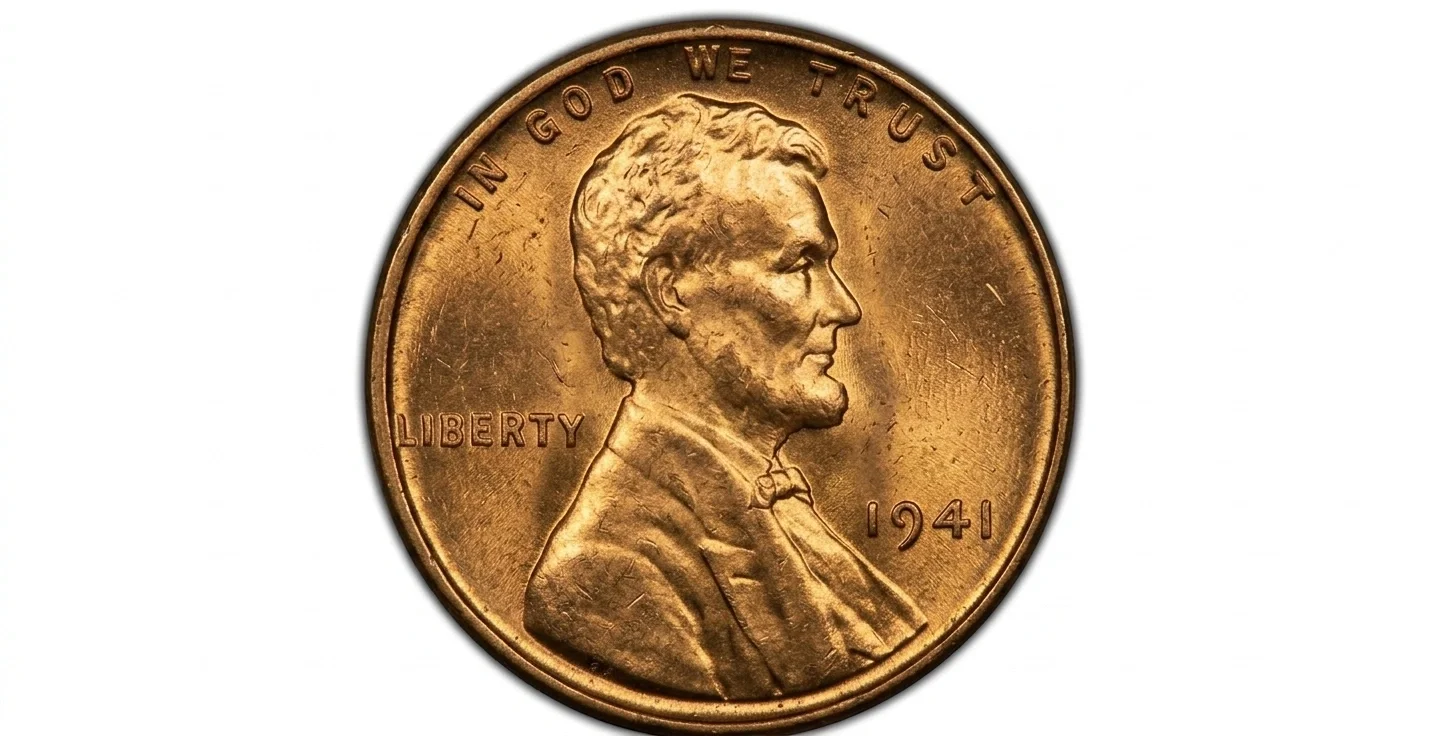
Not all 1941 pennies are equal — even when their differences are nearly invisible to the untrained eye.
Manufacturing during this era reflected America's industrial shift toward wartime production, impacting the consistency of metal surfaces.
Like, 1941 penny value drivers: Visibility of the doubling → 60% of price Surface quality → 40% of price
Metric | Official Value |
Mass | 3.11 grams |
Metal Content | 95% Copper, 5% Tin and Zinc |
Width | 19.05 mm |
Edge | Plain |
Production Type | Business Strike and Proof |
Distribution Across Production Facilities
Three main facilities worked to saturate the economy with small change before the nation officially entered World War II.
Total output reached 1,108,078,000 units, divided among geographical production points.
Facility breakdown: Philadelphia → No mark → 887,018,000 units Denver → D mark below date → 128,700,000 units San Francisco → S mark below date → 92,360,000 units
Pinpointing the origin of a coin serves as the baseline for determining its relative scarcity.
Defining Color Tiers and Preservation Levels
Color classification remains the dominant factor for pricing copper coins in the 2026 market.
Atmospheric reactions naturally change the metal's appearance, moving it between specific commercial groups.
Red (RD) — At least 95% original factory red shine remains
Red-Brown (RB) — A mixture of red shine and darker tones
Brown (BN) — Complete loss of original shine; dark chocolate appearance
Dropping from a Red to a Brown grade leads to a price collapse of 15 to 20 times for identical coins.
Brown specimens typically trade at their raw metal value, roughly $0.02 per unit.
Condition Benchmarks for 1941 Issues
Specialists utilize a numerical system to reflect surface wear and production quality.
Physical damage sustained during circulation removes an object from the high-value category immediately.
Good 4 — Outlines are visible but most details are flat
Fine 12 — Lincoln’s hair is distinct; wheat stalks show smoothing
Extremely Fine 40 — Minor wear on high points; some original shine remains
Mint State 65 — No signs of wear; strong factory luster present
Mint State 67+ — Exceptional surface purity; zero microscopic scratches
Small gaps between MS 66 and MS 67 result in price differences of several hundred dollars.
Rare Production Defects and Die Variations
Minor errors during the stamping process create the highest premiums for 1941 cents.
Using worn or damaged steel stamps resulted in several distinct varieties sought by specialists.
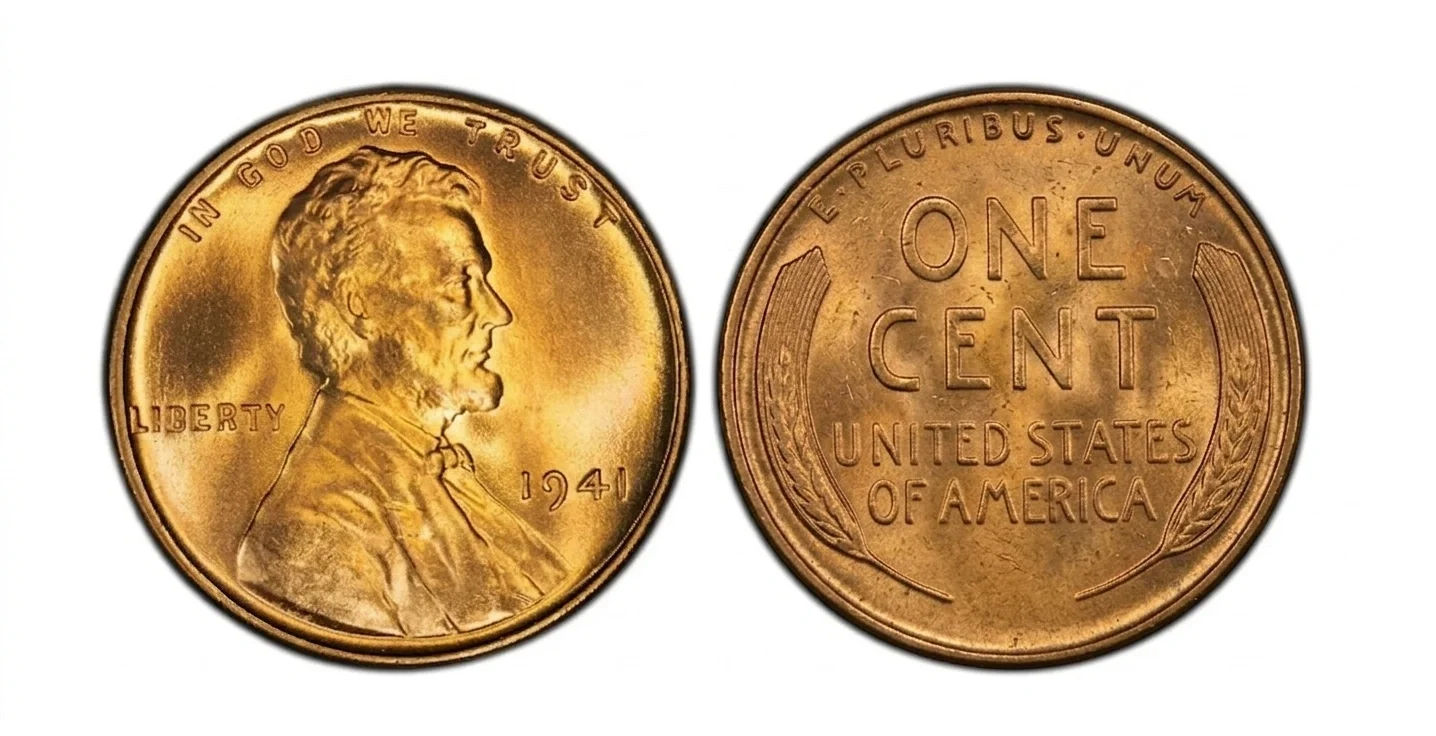
Doubled Die Obverse (DDO)
The most famous 1941 error involves doubling of the date and lettering on the front side.
Mechanical cause of the defect: Stamp misalignment during impact → Overlapping numbers → Permanent metal distortion.
2026 prices for high-end DDO specimens:
MS 64 RD → $600
MS 65 RD → $1,500
MS 66 RD → Record $2,800
Repunched Letter Marks (S/S and D/D)
San Francisco and Denver facilities show cases where the location letter was stamped twice onto the die.
These are classified as Repunched Mint Marks.
An S/S variety in Gem Red condition guarantees a sale above $450 in current 2026 auctions.
Auction Records Comparison
Peak market prices are only achieved by coins verified by PCGS or a coin scanner app.
Origin | Grade | Record Price | Year of Sale |
Philadelphia | MS 68 RD | $2,585 | 2024 |
Denver | MS 68 RD | $3,290 | 2025 |
San Francisco | MS 67+ RD | $1,800 | 2025 |
Philly (Proof) | PR 67 RD | $11,500 | 2022 |
Market trends show Denver coins rising in value faster due to their scarcity in top-tier grades.
Annual price appreciation for MS 67 RD specimens is currently tracking at 5.2%.
The High-Quality Proof Category
Philadelphia produced a limited run of coins specifically for collectors in 1941.
Only 21,100 units were ever struck.
Identifying Proof features:
Mirror-like background surfaces
High-definition details on all elements
Sharp edges on letters and numbers
Prices for Proofs in 2026 start at $150 for PR 63 and reach five-figure sums for perfect samples.
Adding a frosty "Cameo" appearance to the design increases the value by 40% to 50%.
Metal Preservation and Storage Hazards
Copper from 1941 is extremely sensitive to moisture and sulfur in the atmosphere.
Microscopic black "carbon spots" permanently lower a coin’s professional grade.
Value destruction factors: Humidity above 50% → Sulfur contact → Dark patina formation → Shine loss.
Preservation rules:
Use PVC-free plastic holders
Place silica gel in storage containers
Use the free coin identifier app
Avoid touching surfaces with bare skin
Cleaning a coin with chemicals is considered a destructive act in the hobby.
Items with cleaning marks receive a "Details" label and lose up to 80% of their market worth.
Survival Statistics
Most 1941 pennies were destroyed through decades of use or melted for their metal content.
Professional registry data reveals the true number of surviving high-grade coins.
Estimated MS 67 RD population:
Philadelphia — roughly 250 units
Denver — roughly 180 units
San Francisco — roughly 110 units
Supply deficits at the top of the scale create aggressive demand during live sales.
Market analysts track every new certified specimen entering the high-grade category.